- Technology news
- 15 min read
Web Development Companies in Saudi Arabia
Discover the leading web development companies in Saudi Arabia. Learn about core services, web design and development stages, technologies, estimated costs in the Saudi market, and how Nami delivers tailored digital solutions to build a strong web presence.
Website development companies in Saudi Arabia have become important partners for businesses seeking to improve their operations and build digital solutions that support their business goals. A website is no longer just a way to display information; it can become an integrated system for managing orders, organizing customer data, connecting services, and simplifying daily operations.
The success of a project depends on choosing a development company that understands the nature of the business, accurately defines technical requirements, and selects the appropriate software architecture rather than simply building a website that does not meet actual business needs.
In this article, we explore the key criteria for choosing a website development company, the differences between ready-made solutions and custom development, the importance of technical systems and integrations, and the cost of website development, ownership rights, and post-launch maintenance.
We also explore Nami's experience in website development and digital solutions, examples of its projects, and how it can help you choose the right software solution for your business.
Criteria for Choosing a Website Development Company in Saudi Arabia That Fits Your Business
Choosing a website development company in Saudi Arabia should not depend solely on price or the website's final appearance. It also requires evaluating the company's ability to understand project requirements and turn them into a practical, scalable technical solution.
The key criteria to consider include:
-
Understanding the Business: The company should be able to identify the processes your website needs to support, whether that involves receiving orders, managing bookings, or presenting services.
-
Technical Expertise: Evaluate the team's experience in developing websites, systems, and the specific features your project requires.
-
Portfolio: Review previous projects to understand the types of solutions the company has delivered and how relevant they are to your requirements.
-
Clear Scope of Work: Ensure that the required features and expected deliverables are defined before development begins.
-
Scalability: Choose a solution that allows new features to be added and other systems to be integrated as your business grows.
-
Post-Launch Support: Agree in advance on the scope of maintenance, updates, and troubleshooting services.
It is also important to choose a company that can discuss technical alternatives and explain the advantages and costs of each option, helping you make a decision that suits your budget and future plans.
Nami's website development services provide businesses with websites and web solutions tailored to their operations and digital requirements.
The Difference Between Ready-Made Websites and Custom Website Development
Choosing between a ready-made website and one built through custom development affects how the website is managed, how easily it can be developed further, and its overall long-term cost. There is no single option that suits every business; the right choice depends on the project's size and required features.
Ready-Made Websites
These websites rely on pre-built templates or systems that can be customized within their available capabilities. They may be suitable for projects that need to launch a website with common features and a limited budget.
Their main advantages include:
-
Reducing the time required to launch the website in many cases.
-
Taking advantage of ready-made plugins and features.
-
Managing content through established platforms.
-
Lowering initial costs for some projects.
However, limitations may arise when a business requires features that are unavailable in the system or substantial changes to how it operates.
Custom-Developed Websites (Custom Development)
Custom-developed websites are built according to project requirements, with features and technical architecture designed to suit the business and the operations the website needs to perform.
Their main advantages include:
-
Feature Customization: Designing functionality that meets actual business needs.
-
Integration with Other Systems: Connecting the website to external services and systems according to project requirements.
-
Control Over Processes and Data: Organizing data processing to suit the nature of the business.
-
Flexibility and Scalability: Modifying the website and adding new features as the business grows.
Nami adopts the Custom Development approach to build websites and software solutions tailored to each project's needs, supported by Nami's integrated digital services. This approach makes it possible to develop features that suit the business while maintaining the flexibility to modify and expand the solution in the future.
The best choice is the solution that meets your project's current needs and provides the flexibility to develop it without unnecessary technical limitations.
When Does Your Project Need a Custom Web System Instead of a Traditional Website?
A traditional website is suitable when the main goal is to present company information, services, and contact details. However, some businesses require functionality beyond displaying content, making a custom web system a more suitable option.
Situations that may require a custom system include:
-
Order Management: When a business needs to record orders, track their status, and update their details.
-
Customer Portals: When customers need personal accounts to access their information, documents, or orders.
-
Booking Systems: When a service requires appointment scheduling, availability management, and confirmation notifications.
-
Internal Operations Management: When employees need different access permissions and defined workflows.
-
Data Management and Reporting: When a business needs to collect and analyze information and generate operational reports.
-
Multi-Party Services: When a system connects customers, service providers, and administrators through a single platform.
Before development begins, it is important to define the processes the system will handle, the users who will interact with it, the data it needs to store, and the permissions required for each user group.
Nami's technical consulting services help assess project requirements and evaluate potential solutions before defining the development scope, supporting the selection of an architecture suited to business needs.
Integrating Websites with External Systems and Services Through APIs
A website may need to exchange data with other systems to ensure that business operations work together seamlessly. Application Programming Interfaces (APIs) are used to organize communication between systems according to the rules supported by each system.
Examples of integrations include:
-
Online Payment Gateways: Enabling customers to complete payments and track transaction results.
-
Customer Relationship Management Systems (CRM): Transferring customer data and organizing follow-up activities.
-
Shipping and Delivery Systems: Exchanging order information and updating shipping details when the required integration is available.
-
Inventory Systems: Synchronizing product and stock data between the website and internal systems.
-
Accounting Systems: Exchanging transaction and invoice data according to the available capabilities.
-
Messaging and Notification Services: Sending alerts related to orders or other actions.
Connecting systems helps reduce manual data entry, minimize duplicate information, and improve operational tracking. However, successful integration requires checking system compatibility, ensuring that the necessary APIs are available, defining permissions, and establishing error-handling procedures.
When a project requires a mobile app that integrates with its website, Nami's mobile app development services can help assess an appropriate solution based on project requirements.
Technical planning should also document connected systems, the data being exchanged, connection security measures, and responsibilities for maintaining integrations when any system is updated.
The Role of Control Panels in Website and Business Operations Management
A control panel gives teams an administrative interface for managing website features and monitoring operations, eliminating the need to modify code every time information needs to be updated or a recurring task needs to be performed.
Depending on the website's purpose, a control panel may include:
-
Content Management: Editing published pages, articles, images, and information.
-
User Management: Creating and updating accounts and organizing access permissions.
-
Order Management: Reviewing orders, updating their status, and tracking their details.
-
Product and Service Management: Updating prices, descriptions, and availability when needed.
-
Reports and Analytics: Displaying data that helps management monitor business activity.
-
Activity Logs: Recording certain administrative actions to support review and auditing.
It is important not to grant all users the same permissions. Organizing roles helps prevent unnecessary access to sensitive data and functions.
Administrative features should also be designed around everyday workflows. A good control panel is not necessarily the most complex one, but rather the one that enables teams to perform their tasks clearly and efficiently. Alongside the technical structure, Nami's design services can help create user interfaces that suit the project and its users' needs.
Databases and Software Architecture for Websites
Databases and software architecture are essential foundations of website development because they determine how information is stored and processed and how different functions are connected.
Choosing the right architecture depends on several factors, including:
-
Nature of the Data: The type of information the website needs to store and process.
-
Expected Usage Volume: The number of users and operations handled by the system.
-
Functional Complexity: The number of systems and functions that need to be integrated.
-
Security Requirements: Protecting data and organizing access permissions.
-
Scalability: The ability to add new features in the future.
-
Ease of Maintenance: Organizing and documenting code to simplify updates and troubleshooting.
Technologies such as MySQL and PostgreSQL are used to manage databases, while technologies such as Laravel and Node.js are used in website development. The choice depends on the project's nature and requirements.
It is also important to organize the code, document the system architecture, and establish backup and data recovery procedures to simplify maintenance and reduce future technical issues. Alongside the software architecture, Nami's design services help create user interfaces (UI) and improve the user experience (UX), making websites easier to use and better aligned with visitors' needs.
Source Code Ownership and Website Rights After Delivery
Ownership rights and access to files and accounts are important matters to agree on before contracting a website development company. Receiving a website does not necessarily mean that all files, accounts, and permissions have automatically been transferred to the client.
Therefore, make sure the following points are clearly defined in the contract:
-
Source Code: Specify whether source code delivery is included in the agreement and what rights the client has to use and modify it.
-
Design Files and Documentation: Define the files to be delivered, including system documentation and configuration details.
-
Hosting and Domain Accounts: Clarify account ownership and how administrative access will be transferred.
-
Control Panel: Provide the administrative credentials and permissions needed to manage the website.
-
Third-Party Licenses: Identify licenses for templates, libraries, or paid services used by the website.
-
Technical Documentation: Provide the essential information needed to understand, operate, and maintain the system.
-
Post-Delivery Support: Specify the support period, included services, and any additional costs.
These terms should be documented clearly in the contract, including each party's responsibilities for backups, updates, and account security.
Prior agreement helps prevent disputes and gives the business owner greater clarity when managing and developing the website in the future. Nami works to clarify project requirements and delivery scope before development begins, helping clients understand their rights and responsibilities regarding the website, files, and software systems.
Rebuilding Old Websites and Updating Existing Systems
Not every old website requires a complete rebuild; in some cases, partial updates may be sufficient. However, continuing to rely on a system that no longer meets business needs can increase maintenance costs and make it more difficult to add new features.
Signs that your existing website may need a technical assessment include:
-
Difficulty adding new features or modifying existing ones.
-
Dependence on technologies or plugins that are no longer supported.
-
Recurring errors or difficulty identifying their causes.
-
Inability to integrate with systems required by the business.
-
High maintenance costs compared with the value of possible improvements.
-
Limitations in data management or user permissions.
-
Missing technical documentation or code that is difficult to understand.
Before deciding to rebuild the website, it is best to conduct a technical assessment of the existing system, identify which features are working well, determine which issues need to be addressed, and establish which data must be preserved during the transition.
The right solution may involve updating certain components, rebuilding specific sections, or developing an entirely new system. The decision depends on the website's condition, the cost of each option, and the risks associated with the transition.
Website Development Costs in Saudi Arabia and the Factors That Affect Them
The cost of website development in Saudi Arabia varies depending on the project type, required features, level of customization, and technical integrations. There is no fixed price that suits every website, so the project scope must be defined before finalizing the budget.
As a general estimate, costs may fall within the following ranges:
-
Simple Informational Website: Approximately SAR 1,500–5,000.
-
Professional Company Website: Approximately SAR 5,000–15,000.
-
Custom Website with Advanced Features: Approximately SAR 8,000–25,000 or more.
-
E-commerce Store: Approximately SAR 10,000–40,000, depending on features and integrations.
-
Custom Platform or Web System: May start at SAR 20,000–40,000 and exceed this range for large projects.
These figures are estimates, not binding quotations. Actual prices may vary depending on project requirements, the development company, and the technologies used. Nami offers website development solutions at competitive prices tailored to your project's needs and budget, while maintaining a focus on quality and achieving your digital goals.
Factors That Determine Website Development Costs
1. Website Type and Functional Scope
The requirements of an informational website differ from those of an e-commerce store, an order management system, or a multi-user platform.
2. Level of Customization
Specialized features may require additional development and testing compared with using ready-made components.
3. External Integrations
Costs may increase when the website needs to connect to payment, inventory, accounting, or other systems.
4. Technical Architecture and Database
The system's nature and its security, performance, and scalability requirements affect the time needed for development.
5. Data Migration from an Existing System
Transferring content, user accounts, or order records may require additional processing and testing.
6. Maintenance and Operations
Hosting, updates, technical support, and external licenses, where applicable, should be included in the budget.
To obtain a more accurate estimate, request a quotation that outlines the scope of work, included features, operating and maintenance costs, and requirements that can be implemented in later phases.
Technical Support and Maintenance to Ensure Website Continuity
Website management continues after launch because systems and technical dependencies require ongoing attention. Business needs may also change, or technical issues may arise that require resolution.
A support and maintenance plan typically includes:
-
Security Updates: Updating systems and components as needed and checking compatibility.
-
Backups: Maintaining appropriate copies of data and files and testing recovery procedures.
-
Troubleshooting: Identifying and resolving technical issues according to their priority.
-
Operational Monitoring: Tracking errors and critical processes to detect problems early.
-
Change Management: Testing updates before applying them to the live website when necessary.
-
Feature Development: Adding improvements required by changing business needs.
The support agreement should specify expected response times, the scope of included services, how issues should be reported, and any additional costs associated with development requests.
Nami's cloud services can also help identify hosting solutions and cloud infrastructure suited to the operational requirements of digital systems.
How Can Nami Help You Develop a Website That Meets Your Business Needs?
Nami has more than 9 years of experience providing digital solutions and develops websites and software solutions tailored to each project's nature and objectives.
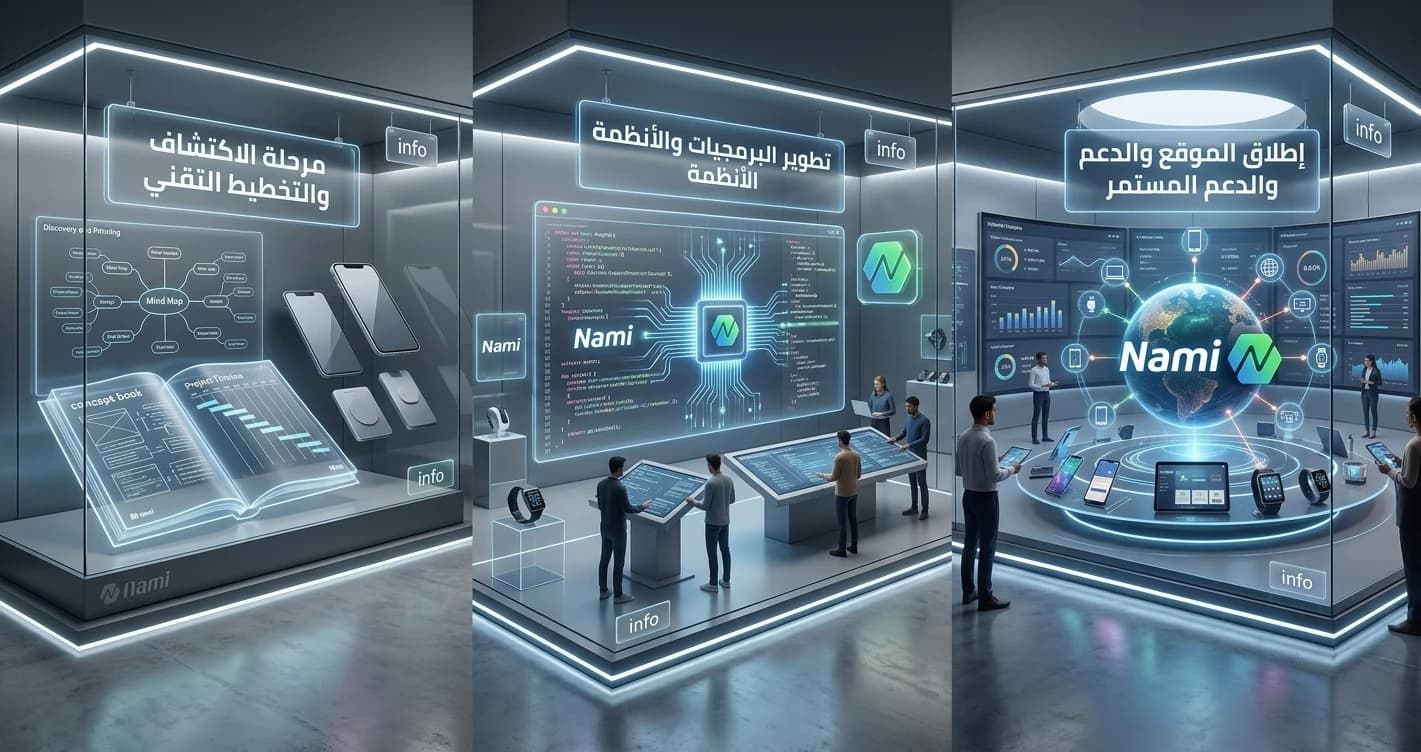
The process begins by identifying business needs and required features, followed by selecting the appropriate technical solution and developing it according to the agreed scope of work.
The available solutions include:
-
Website and System Development: Building websites and web solutions according to project requirements.
-
Technical Consulting: Assessing needs and identifying suitable technical options.
-
Design: Developing interfaces and visual identities that suit the business.
-
Cloud Solutions: Using an operational infrastructure suited to the website's requirements.
-
Digital Marketing: Supporting audience reach and improving the use of digital channels.
-
App Development: Developing a mobile app that complements the website or integrates with its system when needed.
Nami's digital marketing services can help businesses reach customers in line with their objectives.
When a project requires a website and mobile app to work together, Nami's mobile app development services can help assess the right approach based on the project's requirements.
Examples of Website Development Projects Delivered by Nami
Reviewing previous work helps businesses understand the types of projects that can be developed and how technical requirements vary by industry and business needs.
You can explore Nami's portfolio to see examples of digital projects delivered by the company, including:
-
CORE: An informational website for a company operating in the design and construction sector, showcasing its services and projects across multiple areas.
-
Prainsa: A digital project in the construction and concrete sector.
-
Saudi Treasures: A platform related to the tourism sector.
-
Al Nahdi Family Office: An informational website for a family office.
-
15s Meals: A digital project specializing in creating and presenting food recipes.
These examples demonstrate the variety of industries that need web solutions and highlight the importance of defining a website's goals and functions according to the business, rather than relying on a single model for every company.
When evaluating a previous project, focus on how relevant it is to your needs, the features it offers, and the technical solution it uses, rather than judging it solely by its appearance.
Make Your Website an Effective Tool for Business Growth with Nami
If your company needs a new website or wants to improve an existing system, the first step is to identify the features that can improve operations and support your business goals. The right solution may be an advanced informational website, a custom web system, or an integrated platform connected to other services and systems.
Discussing project requirements before development helps define the scope of work, estimate the budget, select suitable technologies, and establish a clear plan for future development and maintenance.
You can contact the Nami team to discuss your company's needs and explore suitable software solutions, whether you are planning to build a new website, update your current website, or develop a web system that supports your business operations.